
The Cheapest Carrier Is Killing You: How AI Selects Freight Partners by Performance, Not Price
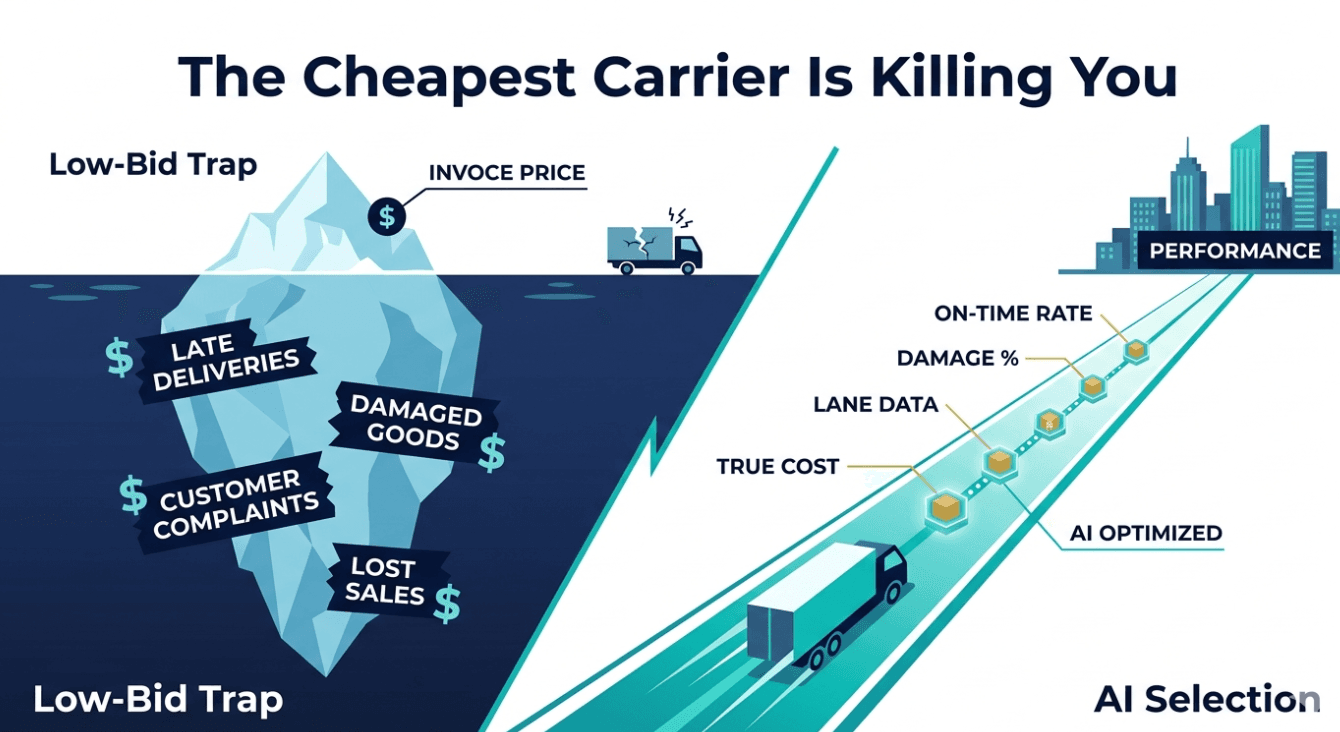
The cheapest freight carrier isn't the cheapest. Learn how AI uses performance data to calculate a carrier's true total cost and eliminate the hidden expense of delays and damage.
The low bid trap
Every logistics manager faces the same pressure. Cut costs. Lower freight spend. Negotiate harder. The easiest response is to award business to the lowest bidder. The cheapest carrier gets the freight. The logistics manager reports savings. Everyone moves on. Then the shipments start. Deliveries arrive late. Product arrives damaged. Customers complain. Support spends hours tracing lost freight. The cheap carrier turns out to be expensive after all.

This is the low-bid trap. It is everywhere in freight procurement. The root cause is focusing on price while ignoring performance. A carrier with a ninety-eight percent on-time rate is worth paying more than a carrier with ninety percent. A carrier with a 0.5 percent damage rate is worth paying more than a carrier with three percent. The savings from lower rates are visible on a spreadsheet. The costs of late and damaged freight are buried in customer service, returns, and lost sales. AI in logistics digs up those buried costs and selects carriers by total cost of ownership, not invoice price.
The iceberg of hidden carrier costs
The freight invoice is the visible tip of the iceberg. Below the waterline are costs that rarely appear on a logistics budget. Late shipments trigger expediting costs. Customers demand discounts for missed windows. Inventory is out of stock longer than planned. Damaged shipments generate return freight, warehousing, inspection, and disposal costs. Lost shipments require investigation time and replacement product costs.
One manufacturer calculated the true cost of their lowest-cost carrier. The carrier saved them twelve thousand dollars annually in freight rates compared to the next lowest bidder. But late deliveries from that carrier cost them thirty-one thousand dollars in expedited shipping, customer credits, and lost sales. Damaged shipments added another fourteen thousand dollars. The cheapest carrier actually cost the company thirty-three thousand dollars more per year than a carrier with higher rates but better performance. The logistics manager had never seen this calculation because no one was tracking hidden costs. They were approving the low bid every year because the low bid was the only number on their spreadsheet.
Why carrier scorecards fail
Most shippers maintain carrier scorecards. On-time percentage. Damage percentage. Claims resolution time. These scorecards are useful. They are also incomplete. They look backward at aggregate performance. They do not predict which carrier will perform best on a specific lane at a specific time of year.

A carrier with excellent national averages might perform poorly on a specific lane from Chicago to Dallas. Another carrier with mediocre national averages might excel on that exact lane. Aggregates hide these differences. AI in logistics moves beyond aggregate scorecards to lane-specific, time-specific, and even shipment-specific predictions. The AI knows that Carrier A has a ninety-eight percent on-time rate overall but only eighty-nine percent on the Chicago to Dallas lane during winter months. Carrier B has a ninety-two percent overall rate but ninety-four percent on that lane in winter. The AI selects Carrier B for that shipment.
The data that matters most
AI in logistics for carrier selection consumes multiple data streams. On-time performance by lane, by month, by day of week. Damage rates by product category. Some carriers handle electronics better. Some handle liquids better. The AI learns these affinities. Claims processing speed and claims approval rates. A carrier that denies legitimate claims saves money on paper. It costs the shipper real money.
The AI also analyses more subtle signals. Tender acceptance rates. A carrier that rejects tendered loads frequently forces last-minute scrambling and premium rates. Equipment availability. A carrier with old, poorly maintained equipment generates more damage claims. Driver turnover. High turnover carriers have inexperienced drivers who make more mistakes. These signals are not on standard scorecards. They are highly predictive of future performance.

Real results from a national retailer
A national retailer shipped over one hundred fifty thousand less-than-truckload shipments annually across forty carriers. Their legacy carrier selection process was simple. Award each lane to the lowest bidder. Renegotiate annually. The logistics team knew performance was declining. They did not know how much it was costing.
They deployed AI carrier selection integrated with their transportation management system. The AI analysed three years of historical shipment data including on-time performance, damage rates, claims costs, and tender acceptance by carrier, by lane, by month. The model then began recommending carrier assignments for each new shipment.
The results were dramatic. On-time delivery improved from eighty-nine percent to ninety-five percent. Damage claims dropped by forty-two percent. Freight spend actually decreased by seven percent because the AI avoided carriers with hidden costs, not because it chased the lowest rate. The logistics manager who had always awarded to the lowest bidder admitted publicly that the AI had proven him wrong. The cheaper carriers were not cheaper. They were just lower on the invoice.
The dynamic bidding problem
Traditional freight procurement happens annually. Shippers issue requests for pricing. Carriers submit bids. Contracts are signed. The market changes the next day. Capacity tightens. Rates rise. The annual contract becomes obsolete. AI in logistics enables continuous procurement. The system evaluates carrier performance and market rates daily. It recommends when to rebid lanes, when to add new carriers, and when to shift volume away from underperforming partners.
One food distributor switched from annual to quarterly carrier reviews guided by AI. They identified three lanes where a previously excellent carrier had degraded significantly. The AI detected the degradation within weeks based on on-time performance and tender rejection trends. The distributor shifted volume to backup carriers before the peak season began. They avoided the service failures that competitors experienced when the same primary carrier collapsed under volume. The quarterly reviews paid for themselves in prevented peak season penalties alone.
The new entrant problem
AI models are trained on historical data. Historical data excludes carriers without history. New carriers are invisible to the model. This is the new entrant problem. AI in logistics solves it through feature-based prediction. Instead of relying solely on a carrier's identity, the model evaluates carrier characteristics. Fleet age. Driver experience levels. Technology stack. Insurance coverage. Safety ratings. Facility locations.
A new carrier with young fleet, experienced drivers, modern tracking, and excellent safety rating receives a high predicted performance score despite having no history with this shipper. The AI recommends a trial allocation of low-risk freight. If performance meets expectations, the allocation increases. This feature-based approach also works for existing carriers when their characteristics change. A carrier that replaces its fleet or hires a new safety director is reevaluated.
The multimodal decision
Many shipments can move via multiple modes. Truckload. Less-than-truckload. Parcel. Intermodal rail. Each mode has different cost structures, different transit times, and different reliability patterns. AI in logistics optimizes mode selection alongside carrier selection.
The AI considers the shipment's characteristics. Weight. Dimensions. Density. Value. Compliance requirements. Delivery window. It considers mode-specific performance. LTL has higher damage rates than truckload but lower cost for small shipments. Parcel has excellent tracking but size limits. Intermodal is cheap but slow and less reliable. The AI selects the mode and carrier combination that minimizes total landed cost including risk of delay and damage.
A chemical manufacturer used AI mode optimization and reduced freight spend by eleven percent while improving on-time performance. The AI shifted full truckload volume from premium LTL carriers to dedicated truckload carriers for large shipments. It shifted small, high-value shipments from LTL to parcel for better tracking and lower damage rates. The multimodal approach outperformed any single-mode strategy.

The collaborative opportunity
Carrier performance data is most valuable when shared. AI in logistics enables collaborative scorecards where shippers share anonymized performance data with each other. A small shipper with limited data benefits from the aggregated experience of dozens of shippers using the same carrier.
One logistics cooperative of forty mid-sized shippers implemented a shared AI carrier selection platform. Each shipper contributed shipment data anonymously. The combined dataset included over two million shipments across hundreds of carriers. The AI model trained on this aggregated data outperformed any individual shipper's model by a wide margin. Members received carrier recommendations based not just on their own experience but on the experience of forty other shippers. Small shippers with insufficient data for their own models received enterprise-grade intelligence at cooperative pricing.
The implementation path for supply chain leaders
Your first step is data consolidation. Gather every freight shipment record from the last twelve to twenty-four months. You need origin, destination, carrier, service level, freight charges, on-time indicator (yes/no), damage indicator (yes/no), claims amount if any, and transit days. You also need tender acceptance data if available. This data may live in your transportation management system, your enterprise resource planning system, and your carriers' portals. Consolidate it into a single repository.
Your second step is baseline measurement. Calculate your current on-time percentage, damage rate, and average claims cost per shipment. Calculate the variability of these metrics by carrier and by lane. This baseline becomes your improvement target.
Your third step is AI deployment. Select a carrier selection platform that integrates with your transportation management system. Run the AI in recommendation mode for thirty days. The AI generates carrier recommendations but does not automatically assign freight. Your logistics team reviews recommendations and decides whether to follow them. Track the AI's recommendation accuracy. How often would following the AI have improved outcome compared to your current process?
Your fourth step is automated assignment. For low-risk lanes where the AI has demonstrated accuracy, enable automated carrier selection. For high-risk or complex lanes, maintain manual review with AI assistance. Expand automation as confidence grows. The entire process from data consolidation to automated assignment typically takes ninety to one hundred twenty days. The improvement in on-time performance and damage reduction is visible within the first sixty days of following AI recommendations.

Conclusion
The cheapest carrier is rarely the cheapest. Hidden costs of late deliveries, damaged goods, and poor customer service dwarf small differences in freight rates. The logistics manager who awards to the low bid is not saving money. They are deferring costs to other departments where they are harder to measure. AI in logistics ends this deception. It calculates total cost of ownership for every carrier on every lane. It recommends carrier assignments that minimize true cost, not invoice price. The result is better service, less damage, and often lower freight spend because the AI avoids carriers that look cheap but deliver expensive problems.
The data exists. The models work. The case studies are documented across industries. The only question is whether your carrier selection process will be driven by AI or by the low-bid trap that has been costing you money for years.
Related Blogs
View All
How AI Pricing Fills Empty Hotel Rooms and Maximizes Revenue
Recent
The Machine Failure: How AI Predicts Breakdowns Before They Stop Production
Recent
How AI Predicts Truck Failures Before They Happen
Recent
The Route That Bleeds Cash: How AI Cuts Fuel Costs Without Reducing Deliveries
Recent