
The Route That Bleeds Cash: How AI Cuts Fuel Costs Without Reducing Deliveries
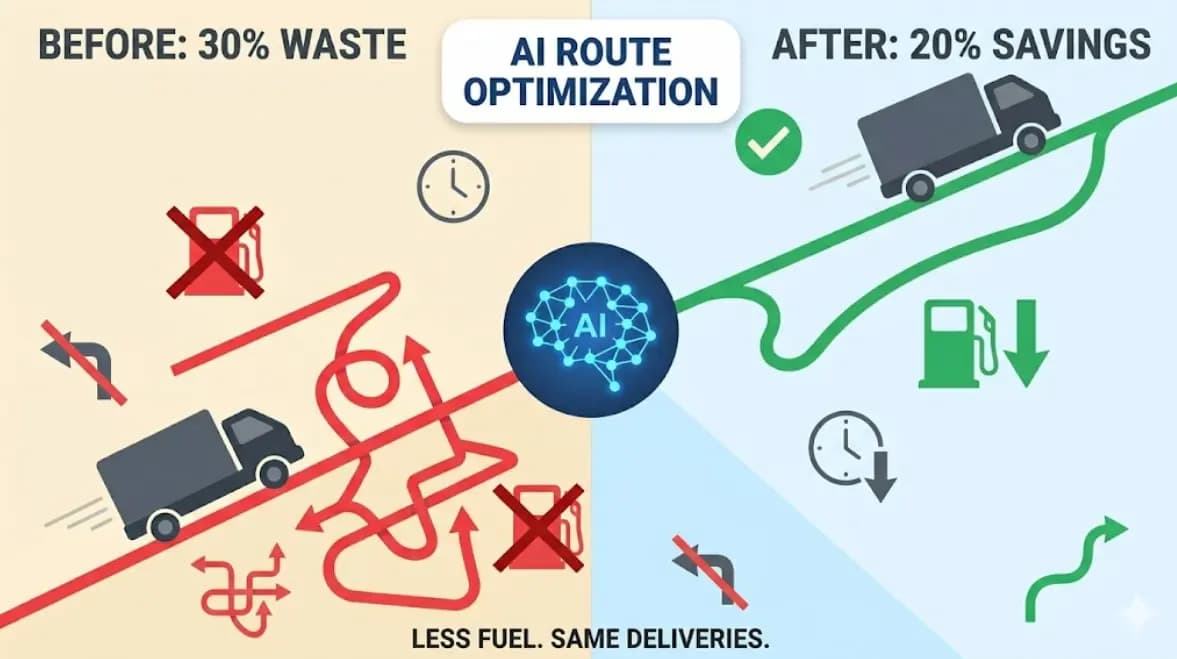
AI route optimization cuts fuel costs by 20% without reducing deliveries — real fleet case study, implementation path, and ROI inside.
The silent waste in every delivery route
Fuel is the second largest expense for any logistics operation. Only labor costs more. Yet most fleet managers treat fuel as a fixed cost. Trucks need fuel. Drivers need to drive. What can you possibly change? The answer is almost everything. The average delivery route contains twenty to thirty percent pure waste. Left turns instead of right turns that force unnecessary idling. Backtracking to missed stops because the sequence was illogical. Idle time waiting between delivery windows that could have been consolidated. Deadhead miles returning empty after a paid drop-off.
This waste is not the driver's fault. It is the route's fault. Human dispatchers build routes based on experience, memory, and educated guesswork. They cannot simultaneously process real-time traffic, changing weather conditions, strict delivery windows, driver hours-of-service limits, vehicle capacity, and turn restrictions. AI in logistics can process all of these variables at once. The result is fuel savings of fifteen to twenty percent without reducing a single delivery.
The math of a million left turns
Every mile a truck drives costs money. Fuel is the obvious and most volatile expense. But maintenance, tire wear, oil changes, and driver wages also scale directly with miles driven. A route that is just ten percent longer than necessary costs ten percent more across all of these operating categories. For a fleet of fifty trucks each driving one hundred thousand miles annually, a ten percent reduction saves half a million miles per year. At a fully loaded operating cost of seventy cents per mile, that is three hundred fifty thousand dollars in annual savings.
AI route optimization finds these savings by solving a problem that is mathematically too complex for humans to solve optimally. The classic traveling salesman problem asks for the shortest possible route visiting all required points. Now add real-world constraints: time windows for each delivery, vehicle weight and volume capacity, driver break requirements, live traffic patterns, and turn restrictions. The problem becomes exponentially harder with every additional stop. AI solves it in seconds using algorithms that mimic natural selection. Each potential route is treated like a chromosome. The AI breeds, mutates, and selects the fittest routes over thousands of generations. The winner saves fuel.
Why human dispatchers cannot compete
Experienced dispatchers develop genuine intuition. They know which neighborhoods clog at 5 PM. They know which drivers prefer highway miles over surface streets. They remember which loading docks are always delayed. This intuition is valuable and should not be discarded. But it cannot scale across a fleet of fifty trucks making five hundred stops daily. The number of possible route combinations exceeds the number of atoms in the observable universe. No human brain can meaningfully explore that solution space.
AI does not replace dispatcher intuition. It enhances it. The AI generates a baseline optimal route in seconds. The dispatcher reviews the proposal, adjusts based on local knowledge the AI lacks (such as a planned construction project not yet in traffic data), and approves the final version. The result combines machine speed with human wisdom. One logistics company tested this hybrid approach against dispatcher-only routing for thirty days. The AI-assisted routes saved eleven percent on fuel with no increase in driver complaints. Dispatchers approved ninety-four percent of AI-generated routes without any changes at all.
Real-time traffic adaptation
Static route optimization calculated once per morning is useful. Real-time adaptation is transformative. AI in logistics monitors traffic conditions continuously throughout the day. When an accident or highway closure blocks the interstate, the AI recalculates optimal routes for every affected truck instantly. Drivers receive new turn-by-turn directions on their in-cab tablets without ever calling dispatch. The complete reroute happens in under thirty seconds.
Consider what happens without this capability. A driver hits unexpected traffic. They sit idle, burning fuel and missing windows. They call dispatch. Dispatch looks at a static map. Dispatch calls other drivers to check alternate routes. The driver waits on hold. Twenty minutes pass. The truck finally moves, but the delay pushes subsequent deliveries directly into rush hour. The cascade effect adds hours and gallons across the entire afternoon. AI eliminates this cascade entirely.
The left turn penalty that kills efficiency
Left turns are the enemy of fuel efficiency for delivery fleets. A truck waiting to turn left across opposing traffic idles for thirty to sixty seconds, burning fuel while going nowhere. The same truck turning right rolls through the intersection with minimal delay. UPS famously redesigned their global routes to minimize left turns and saved ten million gallons of fuel annually. That was a static rule applied uniformly across all conditions.
AI in logistics makes left-turn avoidance dynamic and intelligent. A left turn on a quiet rural road at 2 AM costs almost nothing in time or fuel. The same left turn on a busy urban avenue at 5 PM costs minutes of delay and gallons of wasted idle fuel. The AI knows the difference across every intersection and every hour. It builds turn restrictions into the optimization algorithm intelligently, balancing pure distance against real-world delay. The result is a route that is not the mathematical shortest line but the actual fastest and most fuel-efficient path given live conditions.
How one fleet saved two hundred thousand dollars annually
A regional beverage distributor operated forty delivery trucks serving six hundred retail locations daily across three counties. Dispatchers built routes manually using decades of collective experience. The company knew fuel costs were rising but assumed little could be improved. Routes were already tight. Trucks were full. Drivers worked efficiently.
They deployed AI route optimization as a sixty-day pilot on just ten trucks. The AI ran alongside dispatcher routes but did not override them. The operations team compared the AI's proposed routes to actual dispatcher routes for the same daily deliveries. The AI consistently found savings: shorter distances, less idle time, better sequencing of stops. The pilot trucks using AI routes reduced fuel consumption by fourteen percent. Driver overtime dropped by eighteen percent because routes finished earlier, staying out of evening rush hour. The company rolled AI to the entire fleet within ninety days. Annual fuel savings exceeded two hundred thousand dollars. Overtime savings added another eighty thousand dollars. The software paid for itself in four months.
The driver experience factor
Fuel optimization cannot come at the cost of driver retention. The trucking industry faces a chronic, well-documented driver shortage. Unhappy drivers leave for competitors. Empty trucks do not deliver freight. AI route optimization must balance fuel efficiency with driver satisfaction if it is to succeed long-term.
Drivers hate certain route characteristics. Excessive turns that wear them out. Tight urban streets with nowhere to park legally. Back-to-back deliveries with no time for a bathroom or meal break. Routines that constantly push against hours-of-service limits, forcing rushed driving. AI in logistics incorporates driver preferences directly into the optimization model. Drivers rate route segments as desirable or undesirable via a simple thumbs-up or thumbs-down button. The AI learns these preferences and weights them alongside fuel and time in the optimization algorithm. The result is a route that saves fuel and keeps drivers from quitting.
One fleet found that drivers rejected nearly thirty percent of purely fuel-optimized routes. The AI had created mathematically efficient routes that real human drivers hated. They added driver preference data to the model as a weighted factor. Rejection rates dropped to six percent. Fuel savings dipped slightly from eighteen percent to fifteen percent. The trade-off was worth it. Driver turnover fell by twenty-two percent, saving tens of thousands in recruiting and training costs.
Dynamic re-sequencing for same-day delivery
Same-day delivery is now the baseline customer expectation across most retail and ecommerce segments. Meeting this expectation requires routes that adapt continuously throughout the day. Orders arrive after trucks have already left the depot. Each new order potentially disrupts existing routes. AI in logistics handles this by re-sequencing deliveries dynamically, on the fly.
A truck is halfway through its morning route. A new order comes in for a location near the truck's current position. The AI evaluates in real time whether adding the order is possible within remaining driver hours and delivery windows. If yes, the AI inserts the stop at the optimal position and reroutes the remaining deliveries. The driver receives the updated sequence on their tablet within seconds. No phone calls. No manual replanning by dispatch. No fuel wasted backtracking later in the day to cover the same geographic area twice.
The empty mile problem
Trucks returning empty from deliveries burn fuel while generating zero revenue. Deadhead miles are pure operating cost with no offsetting income. In many fleets, deadhead accounts for twenty to thirty percent of total miles driven. AI route optimization reduces deadhead by proactively finding backhaul opportunities. A truck delivers to a retail store. The AI immediately searches for a nearby supplier or distributor that needs freight transported back toward the truck's home depot. If found, the AI adds the backhaul stop to the route before the driver leaves the retail location.
This capability requires integration with freight matching platforms and load boards. The AI does not just optimize a single fleet's isolated routes. It optimizes across available loads from multiple shippers in the region. One third-party logistics provider implemented AI-powered backhaul matching across their network. Deadhead miles dropped from thirty-two percent of total miles to just nineteen percent. Fuel savings from deadhead reduction alone exceeded three hundred thousand dollars annually, before accounting for the new revenue from the backhaul loads themselves.
The implementation path for logistics leaders
Start with one depot and one delivery zone. Do not attempt fleet-wide deployment immediately. Select a geographic area with clear historical performance data, cooperative drivers, and stable delivery volumes. Run AI route optimization in silent monitoring mode alongside your current human process for two weeks. Compare the AI's planned routes to actual driven routes. Measure differences in distance, planned time, estimated fuel consumption, and driver feedback.
After two weeks of validation, switch the pilot depot entirely to AI-generated routes. Drivers follow the AI directions on tablets. Dispatchers intervene only when the AI makes an obvious error or when local knowledge overrides. Measure actual fuel savings across thirty days. Calculate the difference between historical consumption and post-deployment consumption, carefully adjusting for any changes in delivery volume or mix.
Once the pilot proves success with clear positive ROI, expand to additional depots one at a time. Each deployment takes one to two weeks, including training and validation. The full rollout for a regional fleet of fifty trucks typically completes within ninety days. The software subscription costs are recouped within six months from fuel savings alone. Driver overtime reduction and maintenance savings are additional margin.
Conclusion
Fuel is not a fixed cost. It is a variable cost that responds directly to better routing. AI in logistics unlocks fuel savings that human dispatchers cannot find on their own. The problem is not that dispatchers are unskilled. The problem is that the combinatorial optimization problem is far too large for the human brain to solve optimally across dozens of trucks and hundreds of stops. AI solves the problem in seconds. The fuel savings average fifteen to twenty percent in real-world deployments. Driver overtime drops. Maintenance costs decline because trucks drive fewer total miles. Customer satisfaction holds steady or improves because deliveries arrive reliably on time.
The technology is mature. The integration with existing dispatch systems is straightforward via API. The ROI is measurable in months, not years. The only real decision is when to start. Every month without AI route optimization is a month of burning fuel you could have saved, paying drivers for wasted time, and wearing out trucks on unnecessary miles.
Related Blogs
View All
Artificial Superintelligence: The Future of Intelligence Beyond Humans
Recent
The Machine Failure: How AI Predicts Breakdowns Before They Stop Production
Recent
How AI Predicts Truck Failures Before They Happen
Recent

The Fraud Paradox: How AI in Ecommerce Blocks Criminals Without Blocking Customers
Recent