
The Machine Failure: How AI Predicts Breakdowns Before They Stop Production
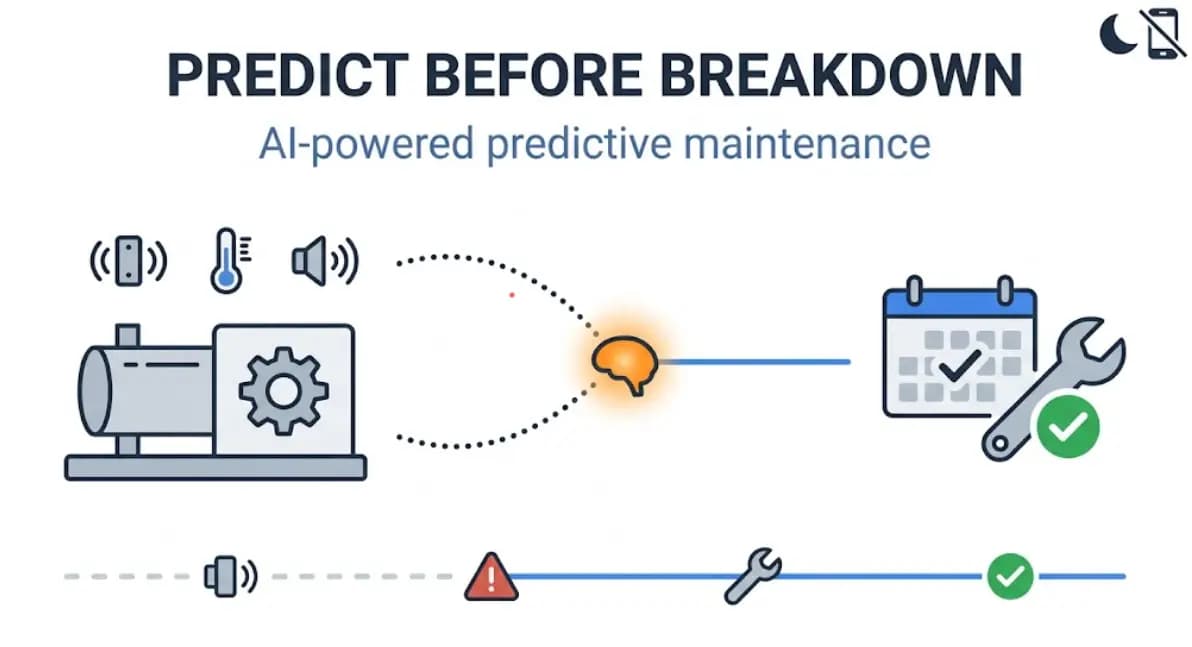
AI in manufacturing predicts machine failures before they stop production. Learn how predictive maintenance reduces unplanned downtime by 40% and saves millions.
The phone call every plant manager dreads
The phone rings at 2 AM. It is the night shift supervisor. A critical machine has stopped. Production is down. The maintenance team is on its way. The cause is unknown. The repair time is unknown. The output loss is already mounting. By morning, the plant manager will explain to headquarters why shipments will be late. Again.
This scene plays out daily in manufacturing plants worldwide. Unplanned downtime costs manufacturers an estimated fifty billion dollars annually. Each minute of downtime on a high-volume line can cost five thousand to twenty thousand dollars. A single two-hour breakdown can wipe out a week's profit margin.
Traditional maintenance is scheduled. Change the oil every thousand hours. Replace the belt every six months. Inspect the bearing every quarter. The approach assumes that components fail at predictable intervals. They do not. Some fail early. Some last much longer than expected. Scheduled maintenance cannot catch the early failures. It also wastes money replacing perfectly functional parts.
AI in manufacturing solves this problem through predictive maintenance. Sensors monitor machine conditions continuously. AI models learn what normal looks like. When signals deviate from normal, the AI predicts an upcoming failure. Maintenance happens exactly when needed. Not too early. Not too late.
The three types of maintenance and why only one works
Reactive maintenance means waiting for failure. The machine breaks. The team repairs it. Production stops. This is the most expensive approach. Emergency repairs cost three to five times more than planned repairs. Rush shipping for parts adds cost. Overtime labor adds cost. Lost production adds the most cost.
Preventive maintenance means servicing on a schedule. Every thousand hours. Every three months. This approach reduces unexpected failures. It also creates waste. Components are replaced while still functional. Labor is spent on unnecessary inspections. Preventive maintenance is better than reactive. It is not optimal.
Predictive maintenance means servicing based on actual condition. Sensors detect early warning signs. The AI predicts failure probability. Maintenance occurs only when needed. This is the optimal approach. No unnecessary replacements. No unexpected breakdowns. Maximum machine availability at minimum maintenance cost.
AI in manufacturing enables predictive maintenance at scale. No human can monitor hundreds of sensors across dozens of machines continuously. The AI can. No human can detect subtle patterns that precede failure. The AI can.
The sensors that see the future
Modern machines generate enormous data. Vibration sensors detect imbalance, misalignment, and bearing wear. Temperature sensors detect overheating from friction or electrical issues. Pressure sensors detect leaks and blockages. Current sensors detect motor degradation. Oil analysis sensors detect contamination and particle accumulation. Acoustic sensors detect unusual sounds that precede mechanical failure.
Each sensor produces data continuously. A single machine may generate thousands of data points per second. The data is too much for human review. It is perfect for AI.
The AI learns the normal range for each sensor on each machine. A vibration frequency of 1.2 kilohertz is normal for Machine 7. The same vibration on Machine 12 indicates a failing bearing. The AI knows the difference because it has learned each machine's unique signature.
One automotive parts manufacturer installed vibration and temperature sensors on two hundred critical machines. The AI monitored every sensor continuously. Within six months, the system predicted forty-three failures before they occurred. The average warning time was eleven days. Maintenance teams scheduled repairs during planned downtime. Unplanned downtime dropped by fifty-eight percent.
How the AI learns what normal looks like
The AI does not come pre-programmed with failure patterns. It learns from your machines. The training period lasts thirty to ninety days. During this time, the AI monitors sensor data without generating alerts. It learns the normal operating range for each sensor on each machine. It learns how sensor readings change under different conditions. Higher load. Different raw material. Ambient temperature.
After training, the AI begins active monitoring. It compares each new sensor reading to the learned normal range. Readings within the normal range generate no alert. Readings outside the normal range generate a deviation alert. Persistent deviations generate a failure prediction.
The AI also learns from actual failures. When a machine breaks despite no alerts, the AI analyzes the sensor data leading up to the failure. It finds patterns it missed. The model updates. The next similar failure is predicted. This continuous learning means the AI gets more accurate over time.
A food processing plant deployed predictive AI and tracked its performance over two years. In year one, the AI predicted twenty-eight failures with an average warning time of eight days. In year two, the AI predicted thirty-five failures with an average warning time of fourteen days. The model improved because it learned from its own mistakes and successes.
The cost of unplanned downtime
Unplanned downtime has direct and indirect costs. Direct costs include emergency repair labor, overtime premium, rush parts shipping, and expedited logistics. A single emergency repair can cost five thousand to fifty thousand dollars depending on the machine and part availability.
Indirect costs are often larger. Lost production is the most obvious. A machine that produces one hundred units per hour that is down for six hours loses six hundred units of output. At a contribution margin of ten dollars per unit, that is six thousand dollars of lost profit.
Downstream disruptions amplify the loss. A bottleneck machine failing creates work-in-progress inventory upstream. Other machines may need to slow or stop. The failure cascades beyond the failed machine.
Customer impact is the hardest cost to quantify. Late shipments trigger penalties. Repeated late shipments trigger lost customers. A single major failure can damage a supplier relationship that took years to build.
AI in manufacturing prevents these costs by predicting failures before they happen. A one-day warning allows the plant to build safety stock. A three-day warning allows the maintenance team to order parts at standard cost, not rush premium. A week warning allows production scheduling to shift work to other lines.
Real results from a heavy equipment manufacturer
A heavy equipment manufacturer operated a plant with five hundred machines. Unplanned downtime averaged one hundred twenty hours per month across the plant. Each downtime hour cost an estimated eight thousand dollars in lost production and repair expense. Annual downtime cost exceeded eleven million dollars.
The company deployed predictive maintenance AI on one hundred fifty critical machines. Vibration, temperature, and current sensors were installed. The AI trained for sixty days. Active monitoring began in month three.
Results after twelve months were substantial. Unplanned downtime on monitored machines dropped by sixty-four percent. Average failure warning time was nine days. Maintenance shifted from emergency to planned. Rush part orders dropped by seventy-two percent. Overtime for maintenance decreased by forty-one percent.
The plant estimated annual savings of five point two million dollars from reduced downtime and maintenance costs. The sensor and AI investment was four hundred thousand dollars. Payback occurred in less than three months. The company expanded predictive AI to all five hundred machines and two additional plants.
The bearing failure pattern
Bearings are the most common source of machine failure. They are also highly predictable. As a bearing wears, vibration at specific frequencies increases. Temperature may rise. Acoustic noise changes. The changes are subtle. A human inspecting the bearing weekly might not notice. The AI monitoring continuously detects the trend.
A bearing that shows increasing vibration over thirty days will likely fail within the next seven to fourteen days. The AI predicts the failure window. The maintenance team replaces the bearing during a scheduled shift change. The machine never stops production unexpectedly.
One paper mill implemented bearing-specific AI monitoring on their drying rollers. Bearing failures had caused several catastrophic breakdowns, each costing over one hundred thousand dollars in repairs and lost production. The AI predicted three bearing failures in the first six months. Each prediction was accurate within plus or minus three days. The mill replaced bearings proactively. Zero catastrophic failures occurred.
The false positive problem
Predictive AI is not perfect. It generates false positives. The AI predicts a failure that does not occur. The maintenance team inspects the machine. They find nothing wrong. Time is wasted. Trust in the AI erodes.
Managing false positives requires threshold tuning. A conservative threshold generates fewer false positives and misses more real failures. An aggressive threshold catches more real failures and generates more false positives. The plant manager chooses the balance.
Most plants start with a conservative threshold. Build trust. Then gradually increase sensitivity. One plant started with a threshold that generated an average of three false positives per week. The team investigated each one. Most revealed minor issues that were corrected before becoming major. After six months, the plant increased sensitivity. False positives rose to six per week. Real failures predicted also increased. The plant determined the trade-off was worth it.
The integration path for plant leaders
Your first step is selecting your machines. Not every machine needs predictive AI. Focus on critical bottleneck machines where downtime is most expensive. Start with ten to twenty machines.
Your second step is sensor installation. Vibration and temperature sensors are the highest value starting point. These sensors install on most machines in one to two days. Wireless sensors are available for machines where wiring is difficult.
Your third step is baseline measurement. Calculate your current unplanned downtime per machine per month. Calculate average repair cost per failure. These baselines become your improvement targets.
Your fourth step is AI deployment. Select a predictive maintenance platform built for manufacturing. Run the AI in learning mode for thirty to ninety days. The AI learns normal behavior during this period. No alerts are generated.
Your fifth step is active monitoring. Switch the AI to alerting mode. Train maintenance staff on interpreting AI predictions. Start with a conservative threshold. Monitor false positive rates and real failure capture rates. Adjust the threshold as needed. Full deployment from sensor installation to active AI typically takes four to six months. Downtime reduction is visible within the first sixty days of active monitoring.
Conclusion
The 2 AM phone call is not inevitable. Machine failures follow patterns. Vibration increases. Temperature rises. Noise changes. The signals are there. Humans cannot watch every signal on every machine continuously. AI can. Predictive maintenance transforms manufacturing operations. Unplanned downtime drops by forty to sixty percent. Emergency repairs become planned replacements. Rush parts become standard orders. The plant runs. The phone stays silent.
Related Blogs
View All
Artificial Superintelligence: The Future of Intelligence Beyond Humans
Recent
How AI Predicts Truck Failures Before They Happen
Recent
The Route That Bleeds Cash: How AI Cuts Fuel Costs Without Reducing Deliveries
Recent

The Fraud Paradox: How AI in Ecommerce Blocks Criminals Without Blocking Customers
Recent