
The Support Crisis: How AI in Ecommerce Cuts Costs and Delights Customers at Scale
Discover how AI in ecommerce cuts support costs by 40%, slashes response times from hours to seconds, automates 70-80% of tickets, and delights customers at scale. Real ROI data included
The Math That Is Breaking Customer Support
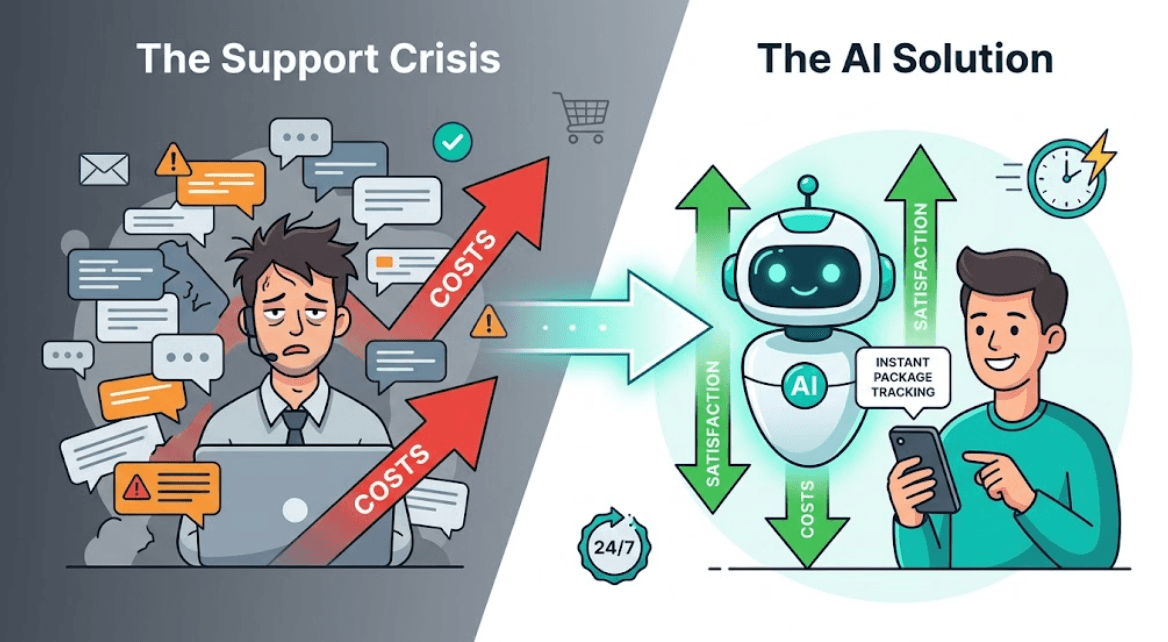
Every ecommerce business faces the same equation. Sales grow. Orders increase. Support tickets multiply. Headcount scales linearly with ticket volume. Costs rise. Margins compress. Customer expectations actually increase as your company gets larger. Faster responses. Better answers. 24/7 availability. The math does not work. You cannot hire your way to great support at scale.
AI in ecommerce breaks this equation. It handles the volume that would require dozens of human agents. It responds instantly when customers expect speed. It works through weekends and holidays without overtime pay. The result is not just lower costs. It is better customer experiences delivered at a fraction of traditional expense.
The Three Costs of Every Support Interaction
Most ecommerce leaders calculate support cost as agent salary divided by tickets handled. This misses two thirds of the real expense. The first cost is direct labor. What you pay the agent to read, research, and reply. The second cost is management overhead. Supervisors, quality assurance, training, scheduling. The third cost is the opportunity cost of slow response. Every hour a customer waits for a reply is an hour they might be buying from someone else.
When you add these three costs together, a simple support ticket asking "where is my order?" often costs eight to twelve dollars to resolve. Not because the question is hard. Because the infrastructure required to deliver the answer is expensive. AI in ecommerce collapses these costs. The direct labor for an AI-handled ticket is near zero. Management overhead scales minimally. Response time drops from hours to seconds, eliminating opportunity cost entirely.
The Tier-One Automation That Every Store Needs
Seventy to eighty percent of all ecommerce support tickets fall into predictable categories. Where is my order? How do I return this? Do you have this in a different size? When will you restock? Can I change my address? Each of these questions has a factual answer that requires no judgment, no empathy, and no creative problem solving. Yet most stores still pay human agents to answer them.
AI in ecommerce automates these tier-one tickets completely. A customer types "where is my order?" The AI retrieves the tracking number from your order management system, checks the carrier API for current status, and replies with the exact location and estimated delivery date. Total time from customer question to customer answer: four to seven seconds.
Real Results From Tier-One Automation
A beauty products retailer deployed an AI chatbot for tier-one support. Within thirty days, the chatbot was handling sixty-five percent of all incoming tickets autonomously. Human agents never saw these tickets. The AI resolved them, and the customer received an answer in under ten seconds. The remaining thirty-five percent of tickets that required human intervention were escalated with full conversation context attached.
The result was a forty-two percent reduction in support labor cost. Average response time dropped from four hours to ninety seconds. Customer satisfaction scores on AI-handled tickets actually exceeded human-handled tickets because the AI never had a bad day, never rushed through a reply, and never failed to include the tracking link.
How AI Knows When to Hand Off to a Human
The worst support automation is the kind that traps customers in a loop. The customer asks a question the bot does not understand. The bot asks for clarification. The customer rephrases. The bot still does not understand. The customer pounds the keyboard in frustration. Good AI in ecommerce avoids this by knowing its own limits.
Modern conversational AI scores each customer message for confidence. If the AI is ninety-five percent certain it has the correct answer, it replies immediately. If confidence drops below fifty percent, the AI routes the conversation to a human agent instantly. The customer never knows they were talking to a bot. The transition happens seamlessly. The human receives the full conversation transcript and picks up exactly where the bot left off.
The Sentiment Detection That Prevents Escalations
The most expensive support tickets are the ones that start small and escalate. A customer is mildly annoyed about a delayed shipment. They contact support. The response is slow. The annoyance becomes anger. The anger becomes a chargeback or a public complaint on social media. AI prevents this escalation by detecting sentiment in real time.
Natural language processing models analyze customer language for frustration signals. Short sentences. Exclamation marks. Negative words like "unacceptable" or "frustrated." When the AI detects rising frustration, it does two things. First, it prioritizes that ticket to the front of the queue. Second, it flags the ticket for the most experienced human agents. Angry customers get fast resolution from skilled staff. Happy customers wait slightly longer. This inversion of traditional queuing dramatically reduces escalation rates.
Generative AI for Response Drafting
For tickets that do require human judgment, generative AI in ecommerce accelerates the human agent dramatically. The AI reads the incoming customer message, retrieves relevant order and product data, and drafts three possible responses for the human to choose from. The human reviews, adjusts, and sends. What used to take three minutes now takes thirty seconds.
A home goods retailer implemented AI-assisted response drafting for their human support team. Average handle time dropped from four minutes to one minute and fifteen seconds. The same team of eight agents now handles the ticket volume that previously required twenty agents. The agents report lower stress because they no longer stare at a blank text box wondering how to start. The AI gives them a first draft. They make it perfect.
The 24/7 Coverage Problem Solved
Customers shop at all hours. They expect support at all hours. Staffing for overnight coverage is expensive and inefficient because ticket volume drops by seventy percent between midnight and 6 AM. AI in ecommerce solves this asymmetry. The AI handles overnight tickets autonomously. The few tickets it cannot resolve are waiting for human agents when they arrive in the morning.
One electronics retailer saved one hundred twenty thousand dollars annually in overnight shift differentials by replacing midnight to 6 AM human agents with AI. Customer satisfaction during overnight hours actually improved because customers received instant answers instead of waiting for a sleep-deprived human. The AI handled ninety-two percent of overnight tickets without escalation.
The Knowledge Base Problem
Most ecommerce support teams maintain a knowledge base of policies, procedures, and product information. Most knowledge bases are out of date, inconsistent, and incomplete. AI in ecommerce solves this by learning directly from resolved tickets. Every time a human agent answers a question, the AI adds that answer to its training data. Over time, the AI learns to answer new questions without explicit programming.
This self-improving capability is the most powerful feature of modern support AI. The system gets smarter every day. The three hundredth customer to ask about international shipping to Australia receives a better answer than the third customer because the AI has learned from two hundred ninety-seven previous answers. Human trainers simply verify and correct. The AI does the rest.
The Voice Support Frontier
Chat is the easiest channel for AI support, but voice is where the biggest cost savings live. Phone support costs five to ten times more per interaction than chat support. New AI voice agents can now handle simple phone inquiries naturally. The customer calls, the AI answers with a natural voice, authenticates the customer using order details or phone number, and resolves the issue without ever routing to a human.
A consumer electronics brand deployed AI voice agents for their returns line. Customers call, state their order number and reason for return, and the AI generates a return label instantly. No hold time. No transfer. No IVR maze. The average call duration dropped from seven minutes to ninety seconds. Customer satisfaction on returns calls increased by twenty-eight points.
The Data Flywheel of Support AI
Every support interaction generates data. That data is valuable beyond the immediate resolution. AI in ecommerce analyzes support tickets to identify product issues, documentation gaps, and training needs. If fifty customers ask "how do I pair the Bluetooth?" the product team knows the pairing instructions are unclear. If thirty customers return the same item for the same defect, the quality team knows where to inspect.
This closed loop between support and product is impossible to maintain manually. The volume is too high. The patterns are too subtle. AI processes every ticket, extracts every signal, and surfaces actionable insights weekly. Support stops being a cost center and starts being a product intelligence engine.
The Implementation Path for Busy Ecommerce Leaders
Start with your most frequent ticket type. For most stores, this is "where is my order?" Build or buy a simple automation that retrieves tracking data and replies instantly. Run it alongside your human team for two weeks. Compare resolution time and customer satisfaction between automated and human-handled tickets.
Once the first use case proves itself, add your second most frequent ticket type. Return policy questions. Size exchange requests. Address changes. Each new use case takes less time than the last because the infrastructure and workflows are already built within sixty to ninety days, you will automate fifty to sixty percent of your ticket volume.
Your human agents will not be bored. They will be focused on complex, high-judgment tickets that actually require human creativity and empathy. They will be happier. Your customers will receive faster answers. Your support budget will shrink. That is the triple win of AI in ecommerce customer service.
Conclusion
Customer support has always been a scaling problem. More sales mean more tickets. More tickets mean more agents. More agents mean lower margins. The math forces a choice between growth and profitability. AI in ecommerce removes that choice. You can grow sales without growing support headcount proportionally. You can improve response times while reducing costs. You can deliver 24/7 coverage without overnight shifts.
The technology is not speculative. It is deployed today across thousands of ecommerce stores. The use cases are proven. The ROI is measurable in months, not years. The only question is whether you will adopt AI support before or after your competitors do. The stores that automate tier-one support first will have lower costs and happier customers. The stores that delay will keep paying the eight to twelve dollar cost per ticket while watching margins shrink.
Related Blogs
View All
Artificial Superintelligence: The Future of Intelligence Beyond Humans
Recent
The Machine Failure: How AI Predicts Breakdowns Before They Stop Production
Recent
How AI Predicts Truck Failures Before They Happen
Recent
The Route That Bleeds Cash: How AI Cuts Fuel Costs Without Reducing Deliveries
Recent